
Since the summer, every state-funded mainstream school in England has received a new grant: the Inclusive Mainstream Fund (IMF). It comes with a deadline. By 31 December 2026, every school must publish an inclusion strategy explaining how it is using the money.
If you’re a SENCo, head or trust leader working out what that means in practice, this guide sets out what’s confirmed, what the money can and can’t be spent on, and some practical ways to plan.
Last checked: 4 October 2026. Policy moves quickly, so check the GOV.UK guidance linked below before making decisions.
What the fund is
The IMF is a direct grant to mainstream schools. The Department for Education says schools should use it to identify and meet commonly occurring needs, and to give early support without needing a diagnosis or a statutory process.
It was trailed on 22 February 2026 and announced the next day in the Schools White Paper, Every Child Achieving and Thriving, by the then Education Secretary, Bridget Phillipson. The fund is confirmed and live. Many of the wider SEND reforms in the same White Paper are still proposals; we cover those separately in The SEND reforms explained.
How much schools get
The IMF is worth £1.6bn over three years (more than £500m a year), of which £400m a year goes to schools. Separate strands cover 16 to 19 providers and early years.
For 2026–27, each school’s allocation is built from:
a £3,000 lump sum for every school
primary: £16 per pupil, plus £79 per pupil with low prior attainment
secondary: £14 per pupil, plus £88 per pupil with low prior attainment
An area cost adjustment applies, and allocations use the October 2025 census. Schools Week calculated average allocations of about £13,500 for a primary and £47,500 for a secondary, but amounts vary widely: 8% of primaries get less than £6,000.
Who gets it, and when
State-funded mainstream schools for ages 5 to 16 are eligible, including maintained schools, academies, free schools and CTCs. Allocations were confirmed in May 2026. The money was paid to local authorities for maintained schools at the end of June, and to academies in early July.
What it can and can’t pay for
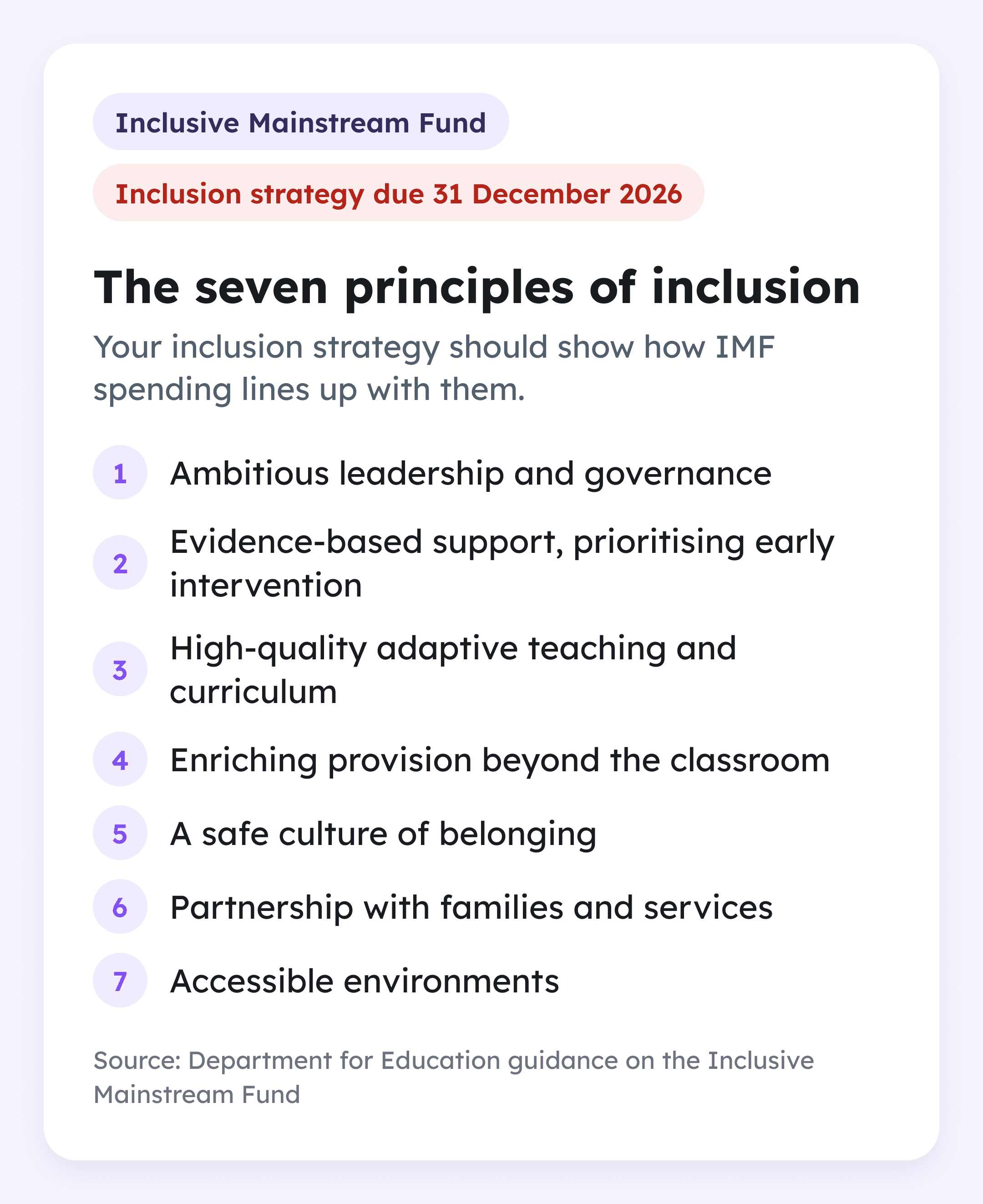
Spending should be evidence-informed and line up with the DfE’s seven principles of inclusion:
ambitious leadership and governance
evidence-based support prioritising early intervention
high-quality adaptive teaching and curriculum
enriching provision beyond the classroom
a safe culture of belonging
partnership with families and services
accessible environments
It can’t be used for general running costs, existing activity, unrelated staff time or capital works.
The 31 December deadline
Every school must publish an inclusion strategy by 31 December 2026, saying how it uses the IMF. Multi-academy trusts publish one per academy, not one for the whole trust. Schools must also keep records of IMF income and spending.
A practical way to plan
There’s no single right answer, but these steps may help:
Check your allocation. Find your 2026–27 figure and confirm where the money sits in your budget.
Map what you already do against the seven principles. Existing activity can’t be funded from the IMF, so be clear about what is new.
Look hard at identification. The fund’s purpose is to spot and meet needs early. Ask how confident you are that you know which pupils need support, and how you found out.
Decide how you’ll show impact. A baseline now makes it much easier to evidence change later, in your strategy and in conversations with governors and inspectors.
Keep records from day one. Income and spending records are a condition of the grant.
Related funding: Experts at Hand and training
The White Paper also announced Experts at Hand, backed by £1.8bn over three years. From September 2026, every local area starts increasing access to speech and language therapists, occupational therapists, specialist teachers and educational psychologists, who work alongside mainstream schools, early years settings and colleges.
Schools don’t apply for Experts at Hand as a grant: it’s organised through your local area, so your local authority is the place to ask how it will work for you. The White Paper also set aside £200m for SEND and inclusion training.
Where screening can fit
The IMF isn’t “for” any particular product, and the DfE doesn’t recommend specific tools. But because the fund is about identifying needs early without waiting for a diagnosis, some schools are making screening part of their plan, whether that’s whole-cohort screening at key points such as Year 3 or Year 7, or screening individual pupils when a concern comes up. Cohort-level results can also help evidence an inclusion strategy, because they show the pattern of need across a class or year group.
One example of whole-cohort screening is Prince Albert Community Trust (PACT), a trust of six primary schools and one secondary school in the West Midlands. PACT screened every pupil to build a baseline of need, which helps teachers plan support in class and helps the trust prioritise which pupils to refer for specialist assessment. In its case study, PACT describes feeling “ahead of the SEND reforms and well-positioned to meet the requirements of the Inclusive Mainstream Fund”.
If you’d like to see what screening results look like in practice, our sample reports show the individual and class-level detail schools receive.
GOV.UK: Inclusive Mainstream Fund for schools: conditions of grant 2026 to 2027
GOV.UK: Inclusive Mainstream Fund for schools: methodology 2026 to 2027
GOV.UK: Every Child Achieving and Thriving (Schools White Paper)
GOV.UK: Local areas prepare new Experts at Hand teams and Supporting SEND reform: developing the Experts at Hand offer
Schools Week, 14 May 2026: Revealed: the uneven split of £1.6 billion inclusion fund
Tes, 25 March 2026: SEND inclusion: what the DfE expects from schools
Talamo case study: Prince Albert Community Trust