Screen from Year 3, before the gap opens
Screen from Year 3, before the gap opens
Screen from Year 3, before the gap opens
Understand every pupil’s strengths and challenges and get practical next steps for teachers and families, whether you screen a whole year group or just the pupils you’re concerned about.
Understand every pupil’s strengths and challenges and get practical next steps for teachers and families, whether you screen a whole year group or just the pupils you’re concerned about.


1,300+ schools
use Talamo across the UK
use Talamo across the UK
25,000+ pupils
screened with Talamo
screened with Talamo
Signposted by the BDA
dyslexia screening, ages 10–16
dyslexia screening, ages 10–16
Why primary schools use Talamo
Built for primary classrooms
Built for primary classrooms
Built for primary classrooms
Spot needs early
Spot needs early
Spot needs early
Find pupils who may need support before difficulties become entrenched, while there’s still time to act.
Find pupils who may need support before difficulties become entrenched, while there’s still time to act.
A whole-year baseline
A whole-year baseline
A whole-year baseline
Screen a full year group, such as Year 3, so no learner is overlooked and you can see who needs universal or targeted support.
Screen a full year group, such as Year 3, so no learner is overlooked and you can see who needs universal or targeted support.
Pupils work on their own
Pupils work on their own
Pupils work on their own
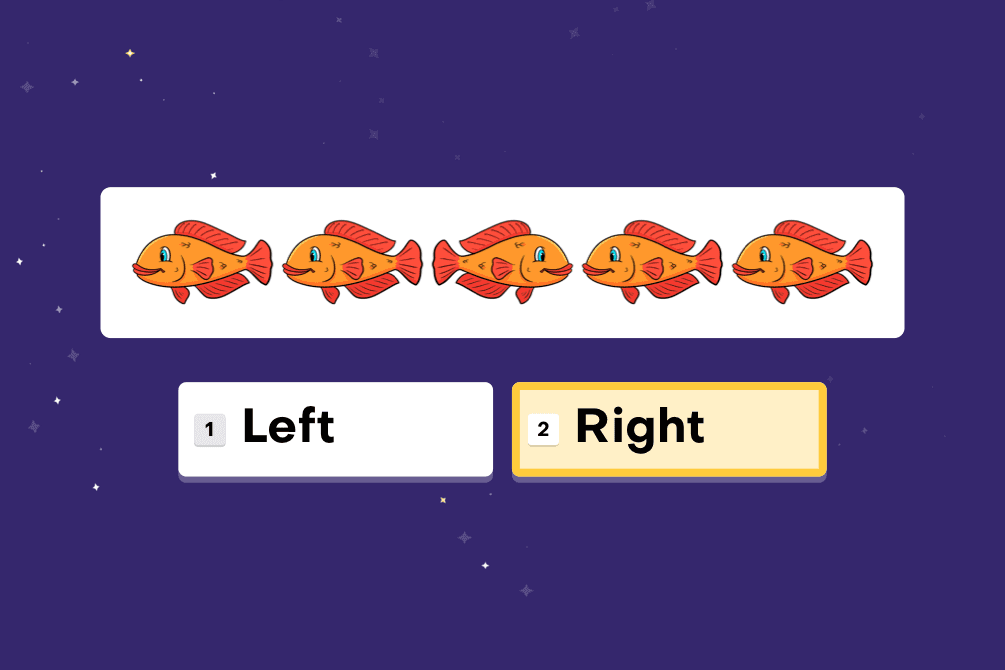
Spoken instructions, practice items and a game-like design mean pupils need little help, with a teacher or TA supervising.
Spoken instructions, practice items and a game-like design mean pupils need little help, with a teacher or TA supervising.
Clear reports for families and transition
Clear reports for families and transition
Clear reports for families and transition
Visual reports make conversations with parents easier and give each pupil a consistent record of their needs when they move to secondary.
Visual reports make conversations with parents easier and give each pupil a consistent record of their needs when they move to secondary.


“
“
“
I liked the visual aspects of the report. Breaking it down really helps talk to families about dyslexia and about the needs of their children.
I liked the visual aspects of the report. Breaking it down really helps talk to families about dyslexia and about the needs of their children.
I liked the visual aspects of the report. Breaking it down really helps talk to families about dyslexia and about the needs of their children.

Rebecca Bye
SENCo, Sevenoaks Primary School
SENCo, Sevenoaks Primary School

The assessments
Three assessments, one picture of each pupil
Three assessments, one picture of each pupil
Three assessments, one picture of each pupil
Run one, two or all three. If a pupil takes more than one, a full report brings their results and recommendations together.
Run one, two or all three. If a pupil takes more than one, a full report brings their results and recommendations together.



From screening to clear next steps
From screening to clear next steps
From screening to clear next steps
Pupils take the assessments in school. A person at Talamo checks every report before you see it, normally within 48 hours.
Pupils take the assessments in school. A person at Talamo checks every report before you see it, normally within 48 hours.
01
01
01
Screen
Screen
Screen
Pupils log in with their own Login ID and work on a school laptop or desktop with headphones, one at a time, in small groups or as a class. An intro video and practice questions help young pupils get going on their own.
Pupils log in with their own Login ID and work on a school laptop or desktop with headphones, one at a time, in small groups or as a class. An intro video and practice questions help young pupils get going on their own.
Spoken instructions
35–45 min, can be split
Teacher or TA supervises

02
02
02
Individual reports
Individual reports
Individual reports
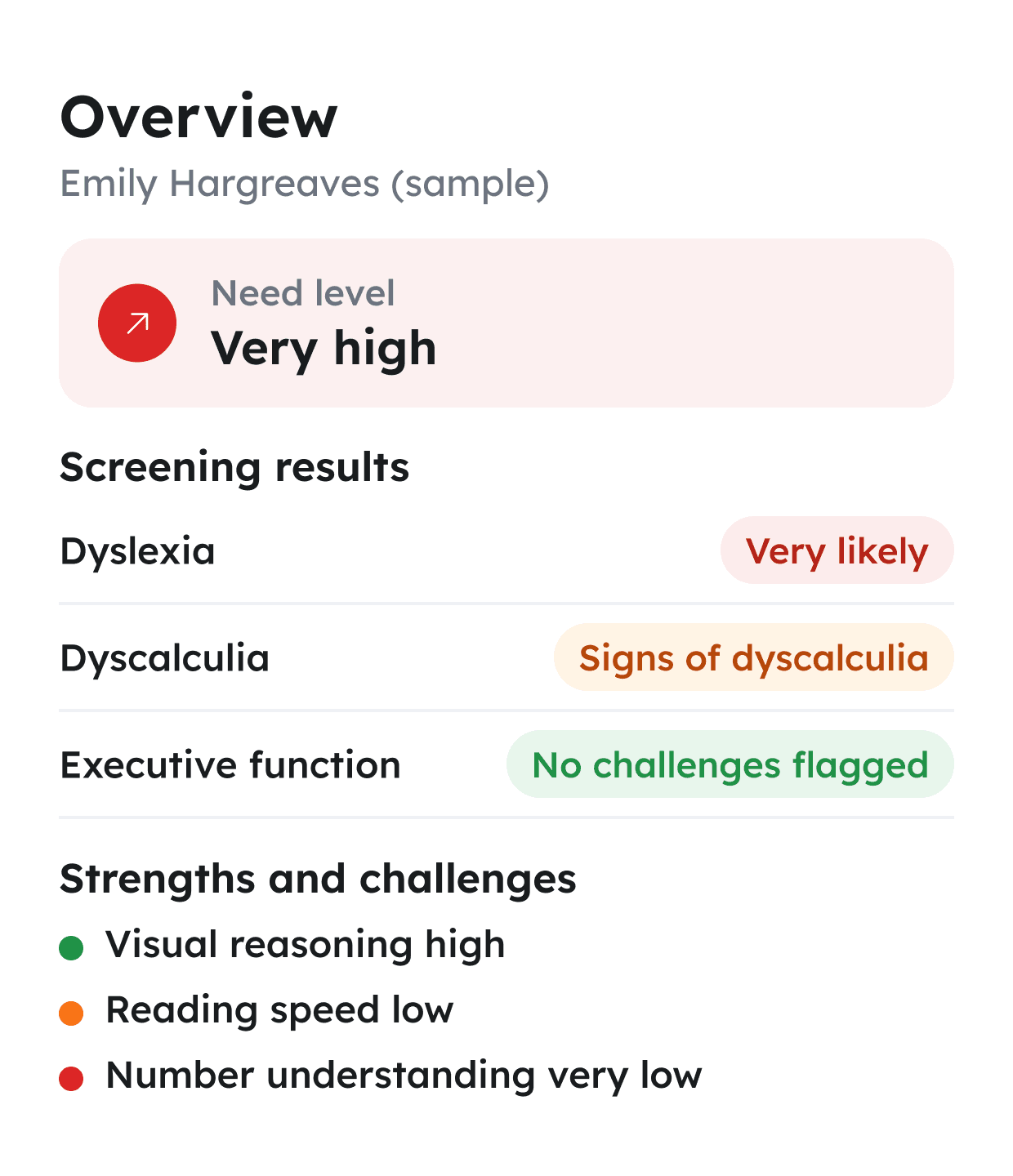
Each pupil gets a report with their strengths and challenges, standard scores, screening indicators (such as dyslexia risk) and a Level of Need, plus practical strategies for the classroom, extra support and home. You decide what to share with parents.
Each pupil gets a report with their strengths and challenges, standard scores, screening indicators (such as dyslexia risk) and a Level of Need, plus practical strategies for the classroom, extra support and home. You decide what to share with parents.
Standard scores
Indicators and Level of Need
Practical strategies
See Emily’s sample report


How to support Emily
For the class teacher. Strategies to use in class.
Target recurring spelling errors
Because spelling scores were low.
Pick one recurring error from Emily’s writing and teach the strategy that fits it, such as grouping words by a shared pattern.
Build in blending and segmenting practice
Because phonological and decoding scores were low.
A few short chances each week to blend sounds in unfamiliar words, and split spoken words into sounds before spelling.
Break tasks into a short visible sequence
Because working memory scores were low.
Write longer instructions as two or three clear steps, and ask Emily to tick off each part as it’s done.

How to support Emily
For the class teacher.
Target recurring spelling errors
Because spelling scores were low.
Teach the strategy that fits one recurring error in Emily’s writing.
Blending and segmenting practice
Because phonological scores were low.
A few short chances each week to blend and split words into sounds.
03
03
03
Cohort reports
Cohort reports
Cohort reports
See a class or year group together: which pupils to prioritise, the needs they share, and strategies for whole-class teaching, intervention groups and further investigation.
See a class or year group together: which pupils to prioritise, the needs they share, and strategies for whole-class teaching, intervention groups and further investigation.
Class and year group view
Priority pupils
Intervention groups

How to support Robin class
Approaches that help the whole class, built into everyday lessons.
Break tasks into a short, visible sequence
Show two or three steps on the board and keep them on display.
Compare examples and non-examples
Put a correct example beside one that looks similar but isn’t, and ask pupils to spot the important difference.
Move gradually from modelling to independence
Show a worked example, complete the next one together, then remove part of the support.
Retrieve what the new learning depends on
Start with a short, low-stakes recap of the knowledge pupils will need in the lesson.

How to support Robin class
For the whole class, in everyday lessons.
Short, visible steps
Two or three steps on the board, kept on display.
Compare examples and non-examples
Ask pupils to spot what makes a correct example different.
These are screening results, not a diagnosis. They show which pupils may need a closer look.
These are screening results, not a diagnosis. They show which pupils may need a closer look.

How primary schools use Talamo
How primary schools use Talamo
How primary schools use Talamo
See all case studies


Primary schools: your questions
Primary schools: your questions
Primary schools: your questions
Common questions from primary SENCos and heads.
Common questions from primary SENCos and heads.
Which year groups can use Talamo at primary?
How much help do younger pupils need?
How do we share results with parents?
How is Talamo priced for primary schools?
Still have a question?
Talk to our team
See what Talamo could show you about your pupils
See what Talamo could show you about your pupils
See what Talamo could show you about your pupils
Book a call with our team. We’ll walk you through a primary sample report and answer your questions about screening in your school.
Book a call with our team. We’ll walk you through a primary sample report and answer your questions about screening in your school.
Emily’s report
Sample report · Year 3 · all three assessments
Dyslexia risk
Likely
Dyscalculia
Typical
Working memory
Low
Book a call
With our team

Get updates from Talamo
A monthly email with news, research and event updates for SENCos, schools and families.
© Talamo Limited 2026. Registered in England and Wales, company number 13714418. Registered office: 3 Buckland House, William Prance Road, Plymouth PL6 5WR.
Get updates from Talamo
A monthly email with news, research and event updates for SENCos, schools and families.
© Talamo Limited 2026. Registered in England and Wales, company number 13714418. Registered office: 3 Buckland House, William Prance Road, Plymouth PL6 5WR.
Get updates from Talamo
A monthly email with news, research and event updates for SENCos, schools and families.
© Talamo Limited 2026. Registered in England and Wales, company number 13714418. Registered office: 3 Buckland House, William Prance Road, Plymouth PL6 5WR.