Spot needs early in Year 7
Spot needs early in Year 7
Spot needs early in Year 7
See each pupil’s strengths and challenges, including needs that went unnoticed at primary, whether you screen a year group or just the pupils you’re concerned about.
See each pupil’s strengths and challenges, including needs that went unnoticed at primary, whether you screen a year group or just the pupils you’re concerned about.


1,300+ schools
use Talamo across the UK
use Talamo across the UK
25,000+ pupils
screened with Talamo
screened with Talamo
Signposted by the BDA
dyslexia screening, ages 10–16
dyslexia screening, ages 10–16
Why secondary schools use Talamo
Built for secondary schools
Built for secondary schools
Built for secondary schools
Year 7 transition screening
Year 7 transition screening
Year 7 transition screening
Screen your whole intake on one measure, whichever primary school pupils came from, so you have a comparable baseline early in the year.
Screen your whole intake on one measure, whichever primary school pupils came from, so you have a comparable baseline early in the year.
Catch needs missed at primary
Catch needs missed at primary
Catch needs missed at primary
Reading loads grow and lessons move faster at secondary. Screening can surface pupils who need support but have never been identified.
Reading loads grow and lessons move faster at secondary. Screening can surface pupils who need support but have never been identified.
Evidence to support access arrangements
Evidence to support access arrangements
Evidence to support access arrangements
Results can support your evidence-gathering, including for Part A of JCQ Form 8. Talamo is a screening tool, so it doesn’t replace the access arrangements process or a qualified assessor’s judgement.
Results can support your evidence-gathering, including for Part A of JCQ Form 8. Talamo is a screening tool, so it doesn’t replace the access arrangements process or a qualified assessor’s judgement.
Clear data for inclusion planning
Clear data for inclusion planning
Clear data for inclusion planning
See patterns of need across a class or year group, so you can plan intervention groups and support. With a statutory Year 8 reading test confirmed, an earlier picture of reading helps you act sooner.
See patterns of need across a class or year group, so you can plan intervention groups and support. With a statutory Year 8 reading test confirmed, an earlier picture of reading helps you act sooner.


“
“
“
The assessments are really easy for us to administer, especially as we can complete a few at a time.
The assessments are really easy for us to administer, especially as we can complete a few at a time.
The assessments are really easy for us to administer, especially as we can complete a few at a time.

Anna Honeyands
SENDCo, The Blue School
SENDCo, The Blue School

The assessments
Three assessments for Years 7 to 11
Three assessments for Years 7 to 11
Three assessments for Years 7 to 11
Run one, two or all three, depending on what you want to understand. If a pupil takes more than one, a full report brings their results and recommendations together.
Run one, two or all three, depending on what you want to understand. If a pupil takes more than one, a full report brings their results and recommendations together.



From screening to every pupil’s next steps
From screening to every pupil’s next steps
From screening to every pupil’s next steps
Pupils take the assessments in school, around your timetable. A person at Talamo checks every report before you see it, normally within 48 hours.
Pupils take the assessments in school, around your timetable. A person at Talamo checks every report before you see it, normally within 48 hours.
01
01
01
Screen
Screen
Screen
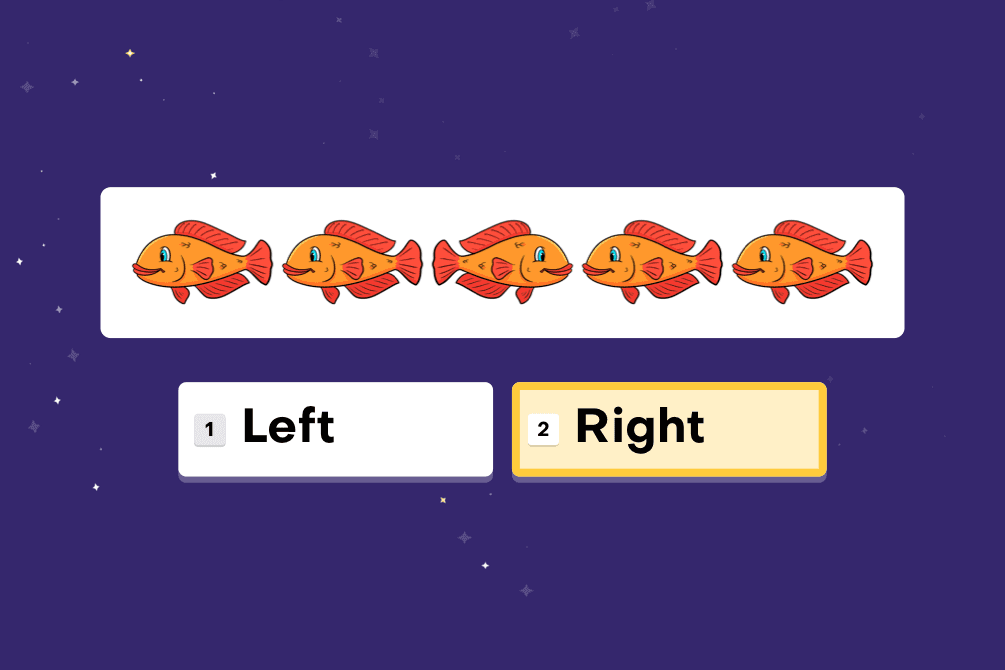
Pupils log in with their own Login ID and work on a school laptop or desktop with headphones, in small groups, whole classes or a rolling programme that suits your rooms. Spoken instructions and practice questions mean no specialist is needed.
Pupils log in with their own Login ID and work on a school laptop or desktop with headphones, in small groups, whole classes or a rolling programme that suits your rooms. Spoken instructions and practice questions mean no specialist is needed.
Class or small groups
35–45 min, can be split
Teacher or TA supervises

02
02
02
Individual reports
Individual reports
Individual reports
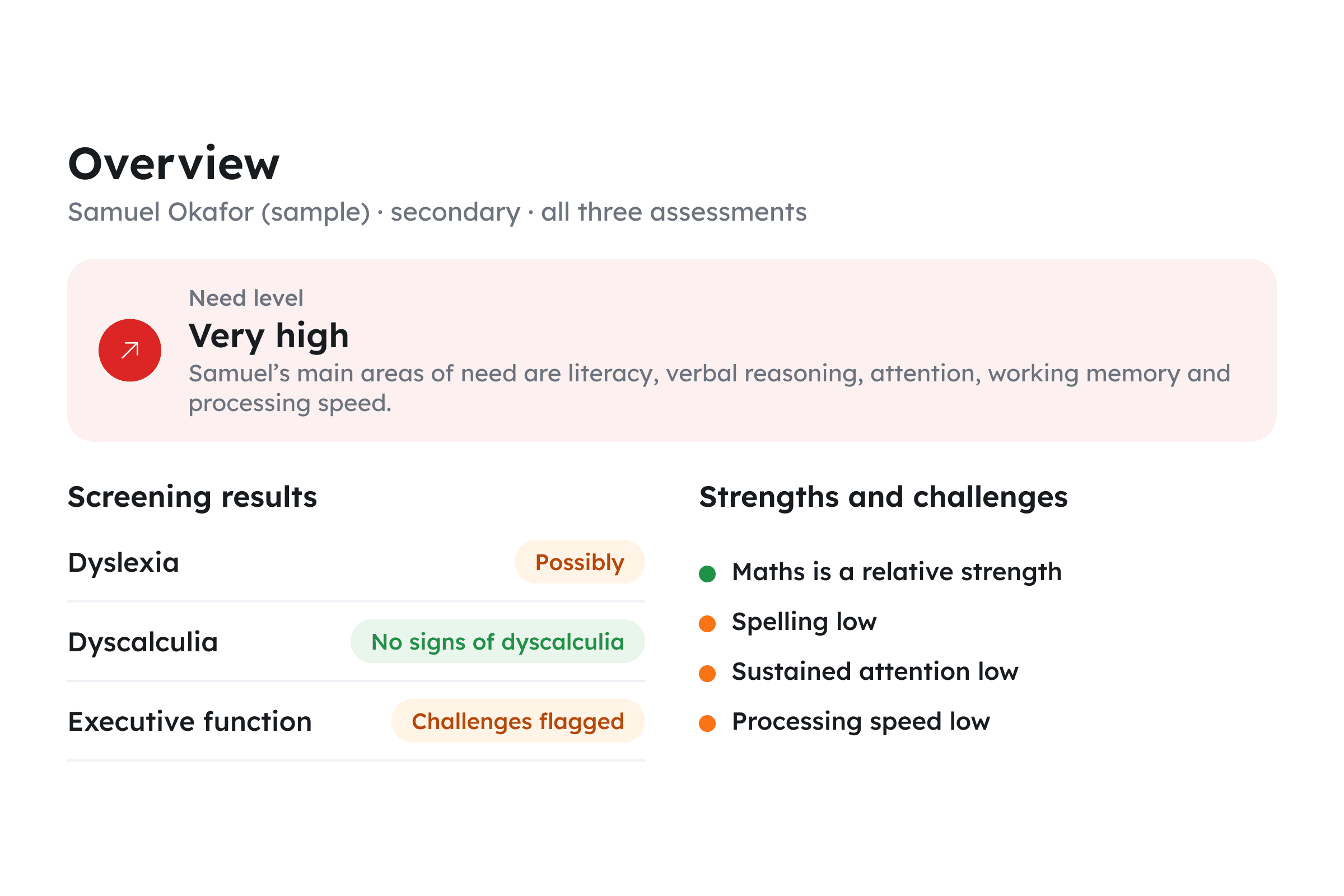
Each pupil gets a report with their strengths and challenges, standard scores, screening indicators (such as dyslexia risk) and a Level of Need, plus practical strategies for subject teachers, extra support and home. Reports also flag when a pupil is worth reviewing for access arrangements.
Each pupil gets a report with their strengths and challenges, standard scores, screening indicators (such as dyslexia risk) and a Level of Need, plus practical strategies for subject teachers, extra support and home. Reports also flag when a pupil is worth reviewing for access arrangements.
Standard scores
Indicators and Level of Need
Practical strategies
See Samuel’s sample report

How to support Samuel
For subject teachers. Practical strategies for secondary lessons.
Mark phrasing in complex sentences
Because the reading-speed score was low.
Help Samuel split a long curriculum sentence into meaningful phrases, model how it should sound, then read the unmarked version.
Structure extended work with checkpoints
Because the attention score was low.
Divide extended independent work into clear stages, each with an expected outcome, and mark each stage as it’s completed.
Plan extra time for demanding work
Because processing speed was low.
Build extra thinking time into complex questions, discussions and extended writing.


How to support Samuel
For subject teachers.
Mark phrasing in complex sentences
Because reading speed was low.
Split long sentences into phrases, model them, then reread.
Checkpoints for extended work
Because attention was low.
Clear stages to tick off one by one.
03
03
03
Cohort reports
Cohort reports
Cohort reports
See a class or year group together: which pupils to prioritise, the needs they share, and strategies for whole-class teaching, intervention groups and further investigation.
See a class or year group together: which pupils to prioritise, the needs they share, and strategies for whole-class teaching, intervention groups and further investigation.
Class and year group view
Priority pupils
Intervention groups

How to support Year 7
Approaches that help the whole group, built into everyday lessons.
Compare examples and non-examples
Useful whole-class foundation.
Put a correct example beside one that looks similar but isn’t, and ask pupils to spot the important difference.
Move gradually from modelling to independence
Useful whole-class foundation.
Show a worked example, complete the next one together, then remove part of the support.
Retrieve what the new learning depends on
Useful whole-class foundation.
Start with a short, low-stakes recap of the knowledge pupils will need in the lesson.

How to support Year 7
For the whole group, in everyday lessons.
Compare examples and non-examples
Ask pupils to spot what makes a correct example different.
Model, then step back
Worked example, then one together, then remove support.
These are screening results, not a diagnosis. They show which pupils may need a closer look.
These are screening results, not a diagnosis. They show which pupils may need a closer look.

Secondary schools using Talamo
Secondary schools using Talamo
Secondary schools using Talamo
See all case studies

Sir Roger Manwood’s School
Secondary
A selective grammar school for ages 11 to 18 in Sandwich, Kent. Its SEN specialist teacher has screened Year 9 classes with Talamo: more than 150 pupils in autumn 2025.
Case study coming soon
Secondary schools
Not sure where to start?
Not sure where to start?
Not sure where to start?
Tell us what you want to find out about your pupils and we’ll help you plan a first step.
Tell us what you want to find out about your pupils and we’ll help you plan a first step.
Book a call
We really enjoy using it. The pupils feel it was easy to use/engage with and the results are fantastic – especially to be shared with home.
We really enjoy using it. The pupils feel it was easy to use/engage with and the results are fantastic – especially to be shared with home.
We really enjoy using it. The pupils feel it was easy to use/engage with and the results are fantastic – especially to be shared with home.
SENCo, secondary school
SENCo, secondary school
Secondary schools: your questions
Secondary schools: your questions
Secondary schools: your questions
Common questions from secondary SENCos and inclusion leads.
Common questions from secondary SENCos and inclusion leads.
Can Talamo support exam access arrangements?
Can we screen all of Year 7?
How does Talamo fit with the new Year 8 reading test?
How is Talamo priced for secondary schools?
Still have a question?
Talk to our team
See what Talamo could show you about your pupils
See what Talamo could show you about your pupils
See what Talamo could show you about your pupils
Book a call with our team. We’ll walk you through a secondary sample report and answer your questions about screening in your school.
Book a call with our team. We’ll walk you through a secondary sample report and answer your questions about screening in your school.
Samuel’s report
Sample report · Year 7 · all three assessments
Dyslexia risk
Possible
Processing speed
Low
Exam access
Worth reviewing
Book a call
With our team

Get updates from Talamo
A monthly email with news, research and event updates for SENCos, schools and families.
© Talamo Limited 2026. Registered in England and Wales, company number 13714418. Registered office: 3 Buckland House, William Prance Road, Plymouth PL6 5WR.
Get updates from Talamo
A monthly email with news, research and event updates for SENCos, schools and families.
© Talamo Limited 2026. Registered in England and Wales, company number 13714418. Registered office: 3 Buckland House, William Prance Road, Plymouth PL6 5WR.
Get updates from Talamo
A monthly email with news, research and event updates for SENCos, schools and families.
© Talamo Limited 2026. Registered in England and Wales, company number 13714418. Registered office: 3 Buckland House, William Prance Road, Plymouth PL6 5WR.