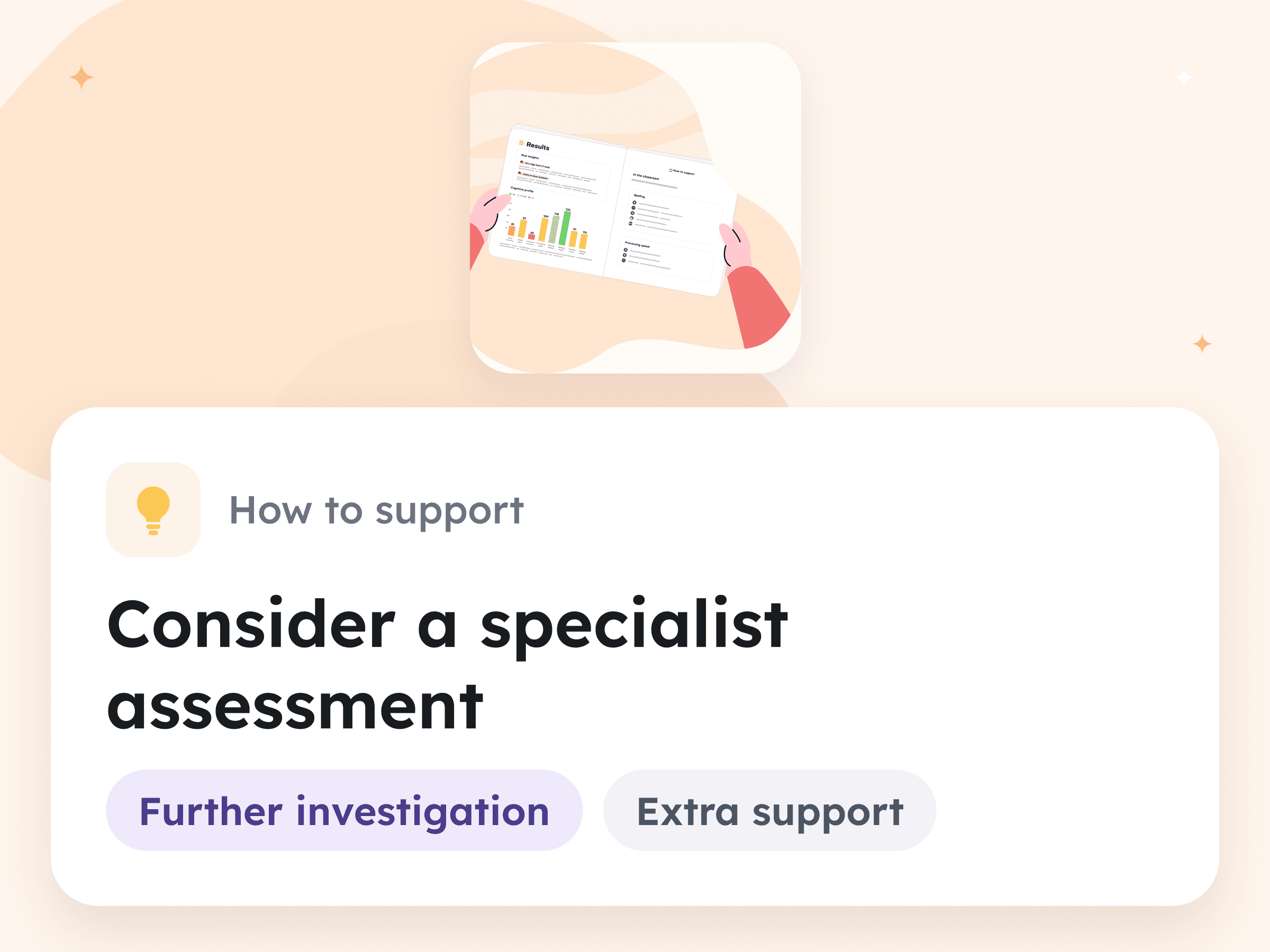
Screening is one of the most useful tools a school has for finding needs early. It’s also easy to ask too much of it. A screening result is not a diagnosis, and it was never meant to be.
This guide explains what screening is for, how to read the results, what else might explain them, and when it’s time to bring in a specialist. We use Talamo’s own assessments as the example, but the principles apply to any screening tool.
Screening triages; specialists diagnose
The simplest way to think about it:
Screening gives pupils the same, consistent check and helps you decide who needs a closer look, and where to look.
Specialist assessment, for example by a specialist assessor or an educational psychologist, is what confirms a diagnosis. A diagnosis can open the door to formal support.
That’s why Talamo’s reports describe results as “consistent with” dyslexia or dyscalculia. They never say a pupil has either. Our Executive Function assessment doesn’t diagnose any condition, and its reports never use diagnostic labels.
Screening results should always be read alongside what you already know: classroom observation, attainment data, and conversations with the pupil and their family.
Reading the results
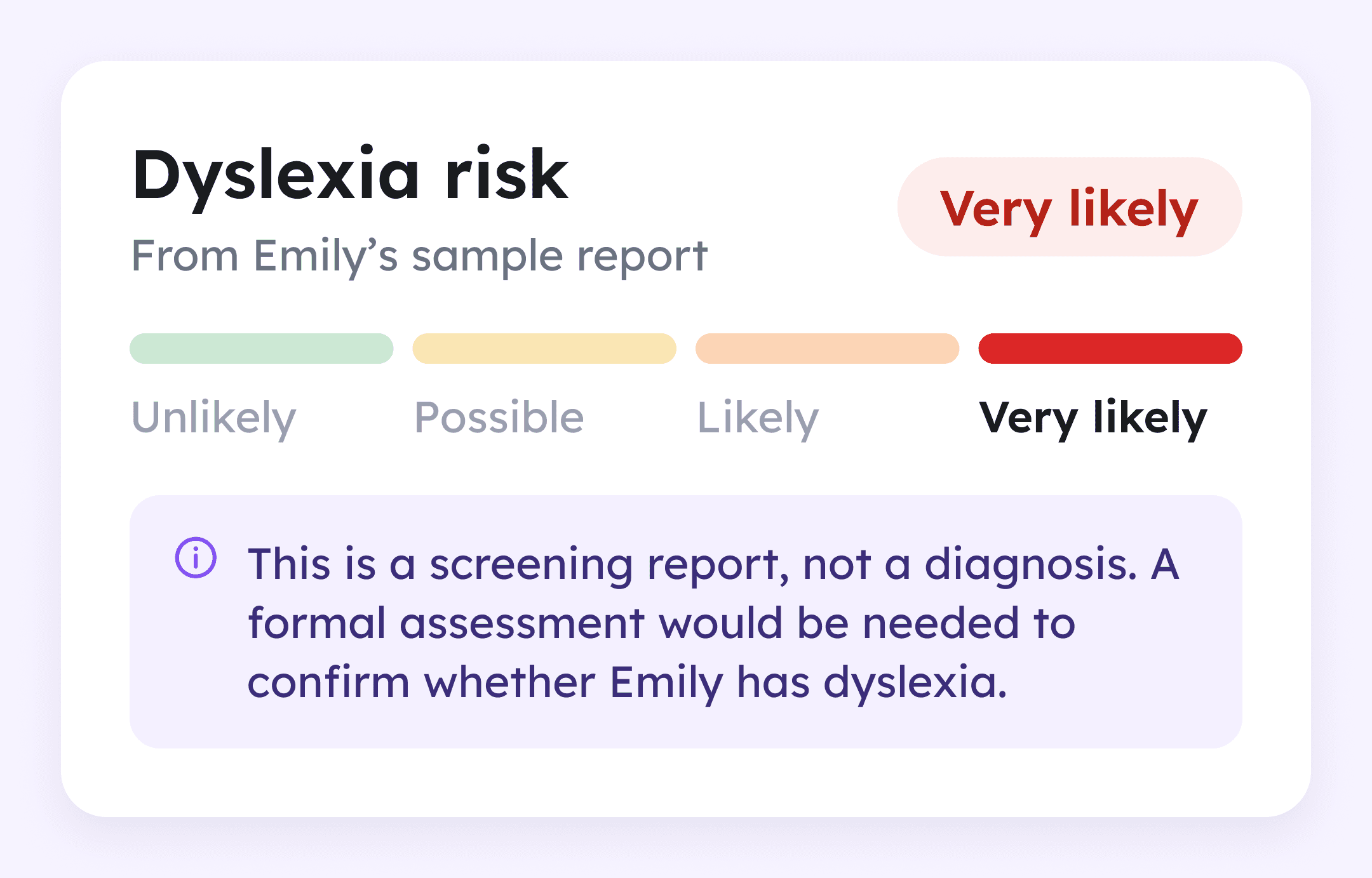
Cognitive & Dyslexia reports one of five risk levels. Risk is a level rather than a yes or no because dyslexia is a spectrum, and screening can’t draw a hard line.
Unlikely: few of the signs associated with dyslexia. Other learning needs may still be present.
Possible: some signs. A specialist check is optional; consider re-screening in a year or two.
Likely: several signs. The results deserve a closer look.
Very likely: a strong pattern of signs. The school or a parent may wish to seek a specialist assessment.
Inconclusive: the results aren’t reliable enough to score. This never means low risk, and a retest is recommended.
Maths & Dyscalculia reports signs of dyscalculia, no signs, or inconclusive, alongside a maths profile showing where difficulty is concentrated. The profile is the headline result. “No signs” doesn’t mean there’s no maths difficulty, and “signs” means further investigation is worth considering.
Executive Function reports executive function challenges, no challenges, or inconclusive, and names the areas driving the result.
All three also give a Level of Need, from Low (ordinary classroom teaching is enough) to Very high (intensive support, with specialist involvement worth considering). It isn’t a diagnostic label: it signals how much support a pupil is likely to need. Because it draws on every Talamo assessment a pupil has completed, it becomes better grounded as more assessments are taken.
See what these results look like in a sample report →
When a result might reflect something else
A screening result is a starting point for questions, not an answer. Our technical manuals list patterns to watch for, including:
English as an additional language. EAL learners may score lower on vocabulary-heavy tasks because of language exposure rather than dyslexia. EAL status never raises Talamo’s dyslexia risk level. In maths, weak word-problem scores alongside strong number skills suggest a language-related difficulty rather than dyscalculia.
Attention. Variable performance, and lower working memory and processing speed, may point to attention difficulties rather than dyslexia.
Processing speed. Slow processing can lower timed maths scores without any underlying number difficulty.
General learning difficulty. Low scores across every area, including reasoning, are more consistent with a general learning difficulty than with a specific profile.
Visual stress. This isn’t measured. Discomfort reading on screen may call for visual support and possibly an optometry review.
A bad day. Executive function performance in particular is sensitive to sleep, mood and motivation. And performance in a structured task can differ from how a pupil manages in class, so both kinds of evidence matter.
What screening can’t do
It’s a snapshot at one point in time. It doesn’t measure development or response to intervention.
It doesn’t cover everything a full diagnostic assessment would, for example rapid naming, reading-aloud accuracy and writing.
Some pupils with a need will be missed, and some without will be flagged. That’s true of any screening tool, so stay alert to what you see in class whatever the result.
When to bring in a specialist
There’s no single rule, but these are good prompts:
A “Very likely” dyslexia risk, especially where it matches what teachers see. A specialist assessment can confirm a diagnosis.
A Very high Level of Need, where intensive support and specialist involvement are worth considering.
“Signs of dyscalculia” or executive function challenges, alongside classroom concern. Referral decisions should draw on the wider picture.
Persistent very low performance. This is a reason to support and refer, not to keep re-testing.
When a result is unusual or inconclusive, check the basics first: supervision, access needs and device issues. Then retest.
Exam access arrangements follow the usual awarding-body (JCQ) process. Talamo results may support evidence-gathering, including for Part A of JCQ Form 8, but they don’t replace the access arrangements process or a qualified assessor’s judgement.
At Prince Albert Community Trust, screening results helped staff triage next steps and prioritise which pupils needed specialist assessment, so the pupils most in need could be seen sooner. You can read how they did it in the PACT case study.
A person checks every report
Every Talamo report is reviewed by a person before it’s released, normally within 48 hours of the pupil finishing. If you have a question about a result, ask us: we’re happy to talk it through.
Want more technical detail? Ask us and we’ll share it.
Talamo Cognitive & Dyslexia technical manual, v1.4 (September 2026): sections 1, 4, 5, 10 and 11
Talamo Maths Difficulty & Dyscalculia technical manual, v1.0 (September 2026): sections 1, 5, 9 and 10
Talamo Executive Function technical manual, v1.0 (September 2026): sections 1, 5, 9 and 10
The technical manuals are available on request: ask us
Talamo case study: Prince Albert Community Trust