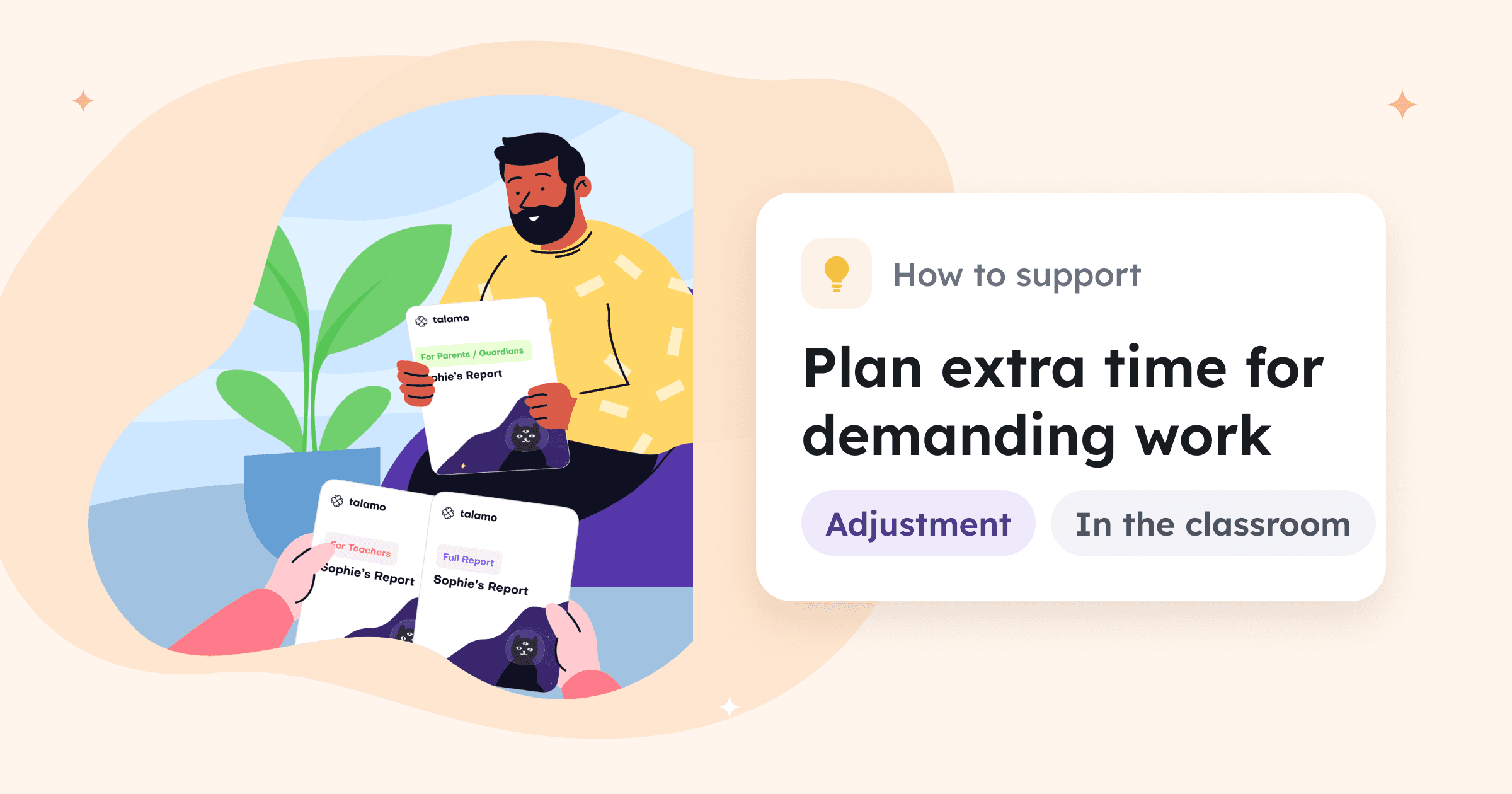
When a pupil is identified as dyslexic, or as showing signs of dyscalculia, the conversation often starts with the label. Labels matter, and we don’t want to pretend otherwise. But on their own, they rarely tell a teacher what to do next. That’s where domains come in.
Why labels can help
Labels can be genuinely useful:
A shared vocabulary. Words like dyslexia, dyscalculia and ADHD give teachers, families and specialists a common starting point, and a way into decades of research and advice.
A route to support. A formal diagnosis can open the door to particular kinds of help, and it gives families something concrete to take to the next conversation.
Identity and understanding. For some young people and families, a name for their experience is a relief. It explains years of struggle, and connects them with others who learn the same way.
So we’re not against labels. Talamo’s reports use them where they help, and carefully: results are described as “consistent with” dyslexia or dyscalculia, and they never say a pupil has either.
Why domains matter more for teaching
A label is a summary, and two pupils with the same label can need quite different support.
Take two pupils whose results are both consistent with dyslexia. One finds it hard to hear and work with the sounds in words, but reads at a reasonable pace once a word is decoded. The other decodes accurately but slowly, and loses the thread of a sentence because so much effort goes into the words themselves. The label is the same. The classroom support isn’t.
That’s why we focus on domains: the specific skills that make up a pupil’s profile. Each Talamo assessment reports them as standard scores, compared with pupils of the same age:
Cognitive & Dyslexia: verbal and visual reasoning, phonological awareness, working memory, processing speed, reading speed, reading comprehension and spelling
Maths & Dyscalculia: number understanding, quantity understanding, arithmetic fluency, applying maths and maths vocabulary
Executive Function: sustained attention, inhibitory control, cognitive flexibility, planning, working memory and processing speed
A profile across these domains shows where difficulty is concentrated, and where a pupil’s strengths are. That points to what to try first: more thinking time for slower processing, visible steps for a pupil who struggles to hold information in mind, short practice with sounds, or diagrams for a pupil whose visual reasoning is strong.
Domains also help with the many pupils who struggle but don’t fit neatly under any label. Dyslexia sits on a continuum rather than being a yes-or-no category, as the 2025 expert consensus on its definition puts it. A profile of skills works along that continuum, wherever a pupil sits on it.
Screening, not diagnosis
Talamo is a screening tool. It helps schools see which pupils may need support and where, and it helps them decide who would benefit from a specialist assessment. A specialist assessment is what can confirm a diagnosis.
The same thinking shapes our Executive Function assessment. We’ve deliberately chosen not to look for ADHD specifically. We felt it could distract from what’s most useful: understanding each pupil’s executive function profile and how to support it.
So the assessment measures executive function processes directly: sustained attention, inhibitory control, working memory, cognitive flexibility and planning. Its reports name the areas behind a result and suggest how to support them. They don’t diagnose ADHD or use the label. For families for whom a diagnosis matters, a specialist assessment is the route to one.
Every report also gives a Level of Need, from Low to Very high. It signals how much support a pupil is likely to need, without attaching a label.
Prefer not to use labels? You don’t have to
Not every school, trust or local authority wants labels at the front of a report, and that’s fine. You can still use our assessments, and the reports can be customised to suit how you work. Either way, the profile of domains and the practical next steps are still there.
What this means in practice
Lead with the profile. Start conversations about a pupil with their strengths and the domains they find harder, not just the headline result.
Plan from the domain. Match support to the specific skill. A working memory difficulty and a phonological one call for different strategies.
Use a label where it helps the pupil. For a referral, a family conversation or a young person who wants to understand themselves, a label can be the right word.
Look across the cohort. Patterns in domains across a class or year group can shape whole-class teaching, not just individual plans.
Whether your school wants to talk about labels, domains or both, we can help you set Talamo up in a way that fits.
Talamo Cognitive & Dyslexia technical manual, v1.4 (September 2026): the nine scales, the eight reported composites, and “consistent with” reporting
Talamo Maths Difficulty & Dyscalculia technical manual, v1.0 (September 2026): the five maths composites
Talamo Executive Function technical manual, v1.0 (September 2026): the composites, and no diagnostic labels
The technical manuals are available on request: ask us
Talamo: sample reports (support suggestions such as thinking time, visible steps and diagrams)
Carroll, J. M., Holden, C., Kirby, P., Thompson, P. A., Snowling, M. J. and the Dyslexia Delphi Panel (2025): Toward a consensus on dyslexia: findings from a Delphi study, Journal of Child Psychology and Psychiatry